This year has once again provided its share of uncertainty for wheat producers, handlers and buyers. We have seen challenges from drought, variable trade policies and the ongoing global pandemic. Through it all, the entire U.S. wheat industry remained fixed on providing the highest quality wheat for almost every customer need, backed by transparent pricing, trusted third-party certification and unmatched service before and after the sale.
As a key part of its commitment to transparency and trade service, U.S. Wheat Associates (USW) has produced its annual Crop Quality Report that includes grade, flour and baking data for all six U.S. wheat classes. The report compiles comprehensive data from analysis of hundreds of samples conducted during and after harvest by our partner organizations and laboratories. The report provides essential, objective information to help buyers get the wheat they need at the best value possible.
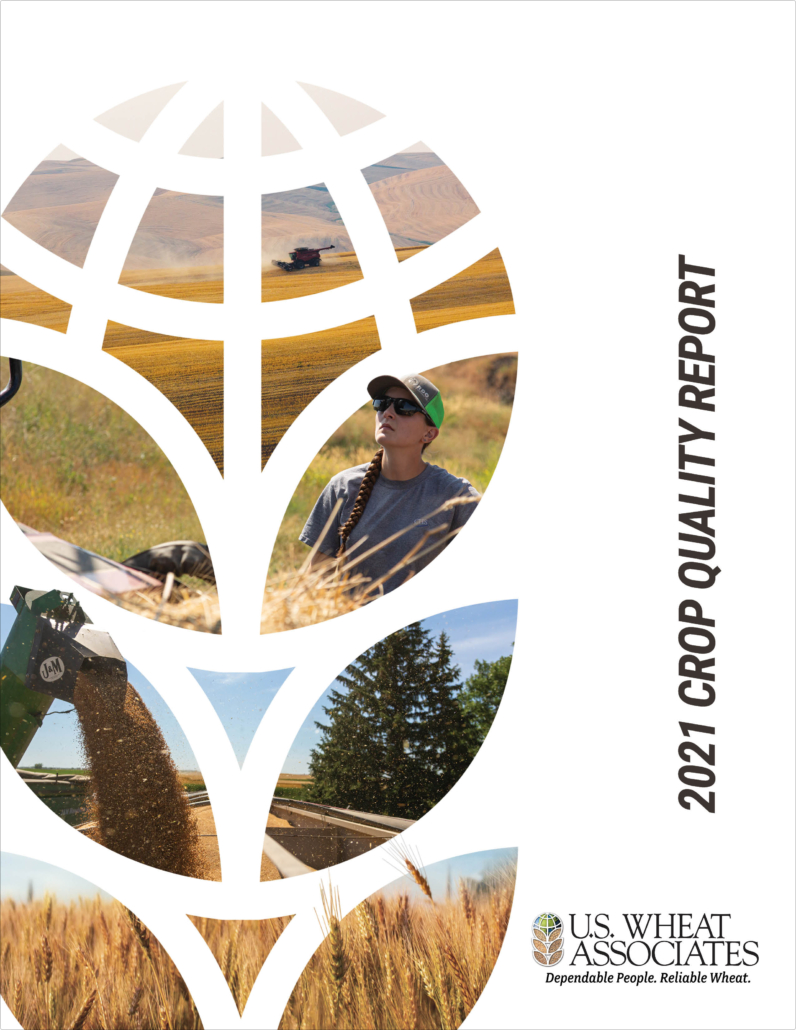 The 2021 USW Crop Quality Report is now available for download in English, Spanish, French, Italian, Arabic and Portuguese. Chinese translations will be available soon. USW also shares more detailed, regional reports for all six U.S. wheat classes on its website, as well as additional information on its sample and collection methods, solvent retention capacity (SRC) recommendations, standard deviation tables and more. View and download these reports and resources here.
New Resources
USW continues to provide unique ways for our customers to experience and gain more knowledge about the 2021 U.S. wheat crop. New this year, USW has expanded its Crop Quality page on its primary website to include unique, individual pages for each of its six wheat classes. When viewing the website, users can access these new pages via the “Crop Quality” tab in the main menu across the top of the website.
For a second year, the pandemic has changed other traditional parts of the USW Crop Quality outreach effort. At https://cropquality.uswheat.org/, customers will find a variety of pre-recorded presentations covering 2021 U.S. wheat crop quality data and analysis, as well as several special topics in English or captioned versions in several different languages.
As always, USW local representatives are ready to help customers review their purchase specifications to receive the best value possible. For more information, please contact your local USW office here.
To Know More, Visit :-
U.S. Wheat Associates (USW) is the export market development
Comments
Post a Comment