
U.S. Wheat Associates Renovated Website Increases Focus On Crop Quality

 U.S. Wheat Associates (USW) recently launched its renovated website, www.uswheat.org, with an updated look, improved organization and an expanded Crop Quality section including unique, individual pages for each of its six wheat classes.

“The pandemic has highlighted challenges and changes in how people communicate and consume information across the globe,” said USW Director of Communications Amanda Spoo, who supervised the update. “So, as we adapt, it is important that our outreach continues to reflect the reliable service our customers have come to expect from U.S. Wheat Associates and the long-standing trust they have in U.S. farmers. The new website maintains its strong focus on the importance of the U.S. wheat farmers we represent and provides customers expanded access to the vital information and resources they need when making their purchasing decisions.”

Crop Quality Focus

The expansion of the site’s original Crop Quality section includes unique, individual pages for all six wheat classes and the existing Harvest Report. Users can access these new pages via the “Crop Quality” tab in the main menu across the top of the website. This section provides users with general wheat class information and additional detailed information about the 2021 U.S. wheat crop. In addition to access to the full 2021 USW Crop Quality Report, available in seven languages, users can access individual regional class reports, an overview of U.S. wheat inspection practices, and more.
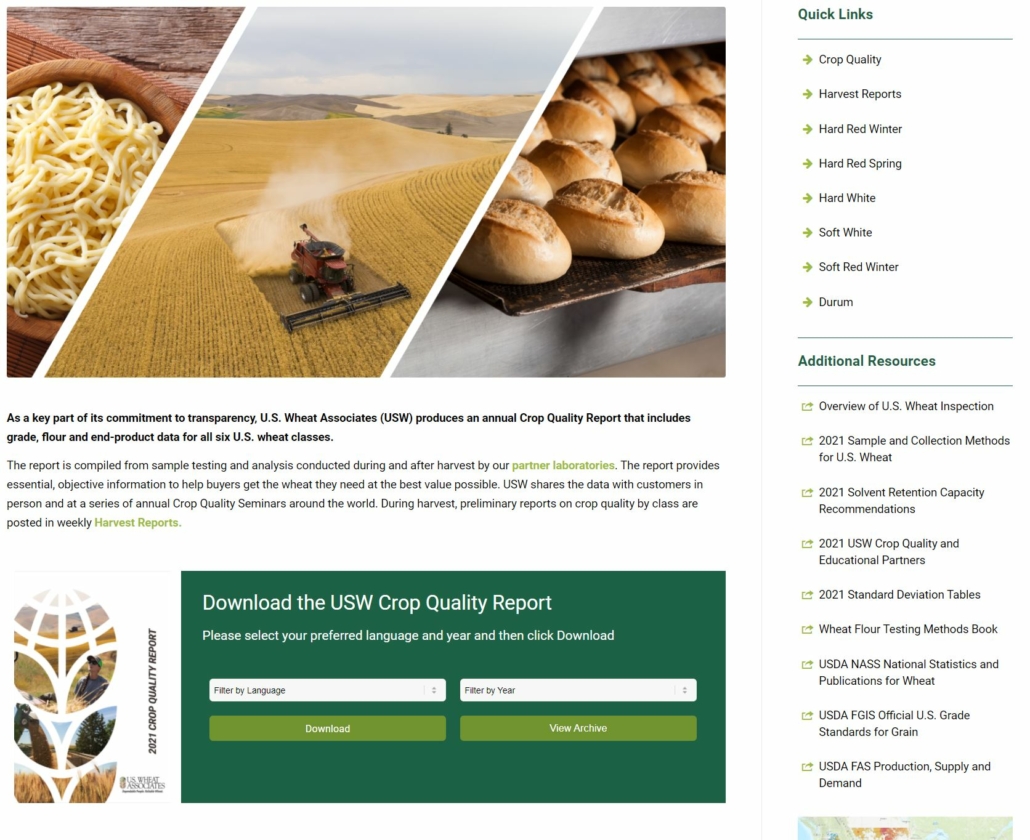
U.S. wheat crop quality website

Other Highlights

  • The Newsroom features our new home base for USW’s blog “Wheat Letter,” news releases, original video content and more.
  • Market Information is home to a familiar set of reports, including the popular Price Report, the Price Charting Tool, Supply and Demand and Commercial Sales.
  • Working with Buyers describes the type of activities USW conducts with its customers, the six U.S. wheat classes and their uses, wheat industry terms, as well as U.S. wheat grade and non-grade factors. The Ask the Expert page allows site visitors to confidentially seek answers to questions about contract specifications, wheat quality, milling and end-product uses, and flour quality. Included in this section is access to our interactive U.S. wheat export supply system map.
  • The Office Locations section, focused on USW’s 15 office locations and the countries they serve, was expanded to provide more information and resources for customers based on the needs of that region and direct access to local USW representatives.
Other important sections of the site include PolicyWho We Represent and Our Story

To Know More, Visit :- US Wheat 

Comments

Popular posts from this blog

How much wheat does it take to make a pound of flour?

  To understand how much wheat it takes to make a pound of flour, it’s important to delve into the  wheat industry , the processes involved in transforming wheat into flour, and the role of organizations like  Wheat Associate.  This information is essential for  wheat food processors  and anyone interested in the journey of wheat from the field to the kitchen. 1. The Basics of Wheat to Flour Conversion On average, it takes approximately 1.25 pounds of wheat to produce one pound of flour. This conversion is a fundamental aspect of the wheat industry, where efficiency and yield are key factors. The slight excess of wheat required accounts for the removal of bran and germ during milling, which are not included in refined flour. 2. The Milling Process The transformation of wheat into flour involves several steps: Cleaning:  Wheat kernels are cleaned to remove impurities such as stones, dust, and other foreign materials. Conditioning:  The cleaned whea...

What is the difference between rice and wheat?

  Rice and wheat are two of the most widely consumed grains globally, each offering distinct nutritional profiles, cultivation methods, and culinary applications. As promoted by the  US Wheat Associates , an organization dedicated to advancing the interests of  US wheat  producers and exporters, understanding these differences is crucial for making informed dietary and agricultural choices. Wheat, a staple in many parts of the world, belongs to the Triticum genus and is commonly ground into flour for making bread, pasta, and pastries. It contains gluten, a protein complex that provides elasticity to dough, aiding in the rising process. This makes wheat-based products popular choices for baking, resulting in fluffy and chewy textures. Wheat's versatility is showcased through its various forms like hard red, soft red, and durum, each suited for specific applications. Rice, on the other hand, is a cereal grain primarily grown in flooded fields known as paddies. It is a ...

How is wheat harvested, and what effect does this have on the environment?

 Wheat is a critical crop for the United States and is one of the most widely cultivated grains in the country. It is used to make a wide range of foods, from bread and pasta to cereal and snacks. In this article, we will explore the process of harvesting wheat in the United States, as well as its environmental impact. Harvesting Wheat in the USA Wheat is typically planted in the fall or spring and grows through the winter or summer months, depending on the variety of wheat. When the wheat is ready to be harvested, farmers will use a combine harvester to cut the stalks of wheat, separate the grains from the chaff, and collect the grain in a bin on the combine. The combine harvester is a large machine that is driven through the fields of wheat. It has a cutting header at the front, which cuts the stalks of wheat close to the ground. The wheat is then fed into a threshing drum, which separates the grain from the straw and chaff. The grain is then collected in a bin on the combine, wh...