With the COVID-19 pandemic still lingering in 2021, U.S. Wheat Associates (USW) continued to provide reliable, high-quality service to customers worldwide via virtual programming. The pandemic’s start quickly brought challenges that no industry in modern history had experienced on such an immediate, global scale. However, USW quickly pivoted and adapted its programs. That experience and valued feedback we received better prepared USW to improve and expand virtual programs in 2021.
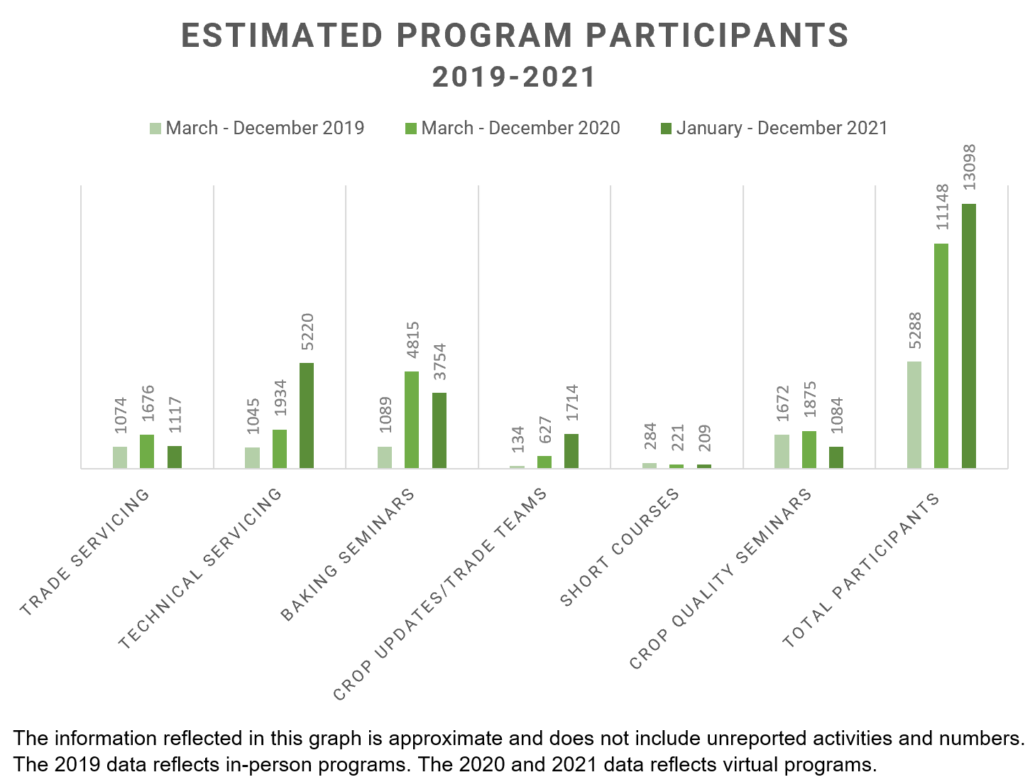
USW conducted more than 315 virtual programs in 2021 and reached over 13,000 participants. This increased from 296 virtual programs and 11,000 participants in 2020, even as some regions slowly began implementing in-person activities again this year. The chart below showcases a breakdown of the types of USW programs and compares virtual participant reach in 2020 and 2021 to pre-pandemic, in-person participant numbers in 2019.
“Marketing year (MY) 2021/22 combined ending stocks of major wheat exporters are projected to reach their lowest level in more than ten years. This tighter supply outlook among exporters pushed wheat prices to historically high levels, and adverse global weather

Mike Spier, USW Vice President of Overseas Operations
conditions intensified market volatility,” said USW Vice President of Overseas Operations Mike Spier. “In 2021, USW overseas staff rose to the challenge and increased the number of customers reached through crop and market updates by more than 1,000 participants compared to similar programs in 2020. This increased frequency in virtual programs and timely market information kept buyers around the world informed of the latest wheat price, production and quality trends, helping them navigate tighter supplies, price volatility and challenges brought on by the pandemic.”
In 2021, USW hosted a new monthly webinar series, “Creating Value for U.S. Wheat,” hosted by Mark Fowler, USW Vice President of Global and Technical Services. With assistance from Catherine Miller, USW Programs Coordinator, the seven-part series featured technical topics and current market trends such as solvent retention capacity (SRC), flour blending, flour particle size impact, stream selection and more. Webinar speakers included USW’s in-house technical staff, including Fowler, Roy Chung, Ivan Goh, Tarik Gahi, Peter Lloyd and Andrés Saturno. The monthly webinars ran from April to October and reached more than 1,840 participants.
Another highlight from USW’s 2021 virtual programming was the first-ever “School of Wheat Quality Course.” USW collaborated with Dr. Senay Simsek, Purdue University, and Brian Sorenson, Northern Crops Institute (NCI), who designed and executed two intensive 6-week virtual sessions for customers in South and Southeast Asia. Participants took a deep dive into the various steps of wheat quality testing from field to table through live-streamed lectures and demonstrations. Benchmark exams were conducted throughout the 6-week course and were a requirement for graduation—a helpful tool to ensure participants stayed engaged.
“These courses provided foundational instruction on testing wheat and flour quality. Training mill staff how to accurately measure quality parameters and compare attributes offered by different types of wheat helps illustrate the superior quality of U.S. wheat classes,” said USW Regional Vice President for South Asia Joe Sowers. “Courses like this are a win-win for USW and our stakeholders. They facilitate the success of collaborating millers while proving the value proposition of using U.S. wheat.”
For the U.S. wheat industry and its overseas customers, who share historically long connections, meeting together in person here and abroad has always been paramount to its successful relationships. While the value of face-to-face activities is irreplaceable, the unique opportunity to increase USW’s reach to customers has become a silver lining to the challenges brought on by the pandemic. Going forward, USW sees the value in leveraging a mix of in-person and virtual programming to best serve its customers.
To Know More, Visit: US Wheat Associates
Comments
Post a Comment