
U.S. Wheat: Still The World’s Most Reliable Choice


The world’s wheat buyers have heard the claim that dependable U.S. farmers produce “the world’s most reliable choice.” U.S. Wheat Associates (USW) and the farmers we represent believe in that claim because so many customers rely on several classes of U.S. wheat to meet their specific end-use and quality needs and because importing U.S. wheat carries less risk.

The situation the world’s wheat buyers see today is uncertain. Prices are up. Exportable supplies are down. Possible market disruptions are looming.

Fortunately, overseas customers know they can depend on the integrity of the U.S. supply chain, the quality of U.S. wheat and our unmatched reliability as a supplier. Here is why U.S. wheat remains the world’s most reliable choice.

The U.S. “Wheat Store” is Always Open

U.S. farmers overcome significant risk every year to meet domestic wheat demand and still provide half their crop for export markets. Farmers and commercial warehouses can store and efficiently transport wheat in top condition to meet overseas demand when needed and throughout the marketing year.

Prices are Transparent and Honored

U.S. wheat export prices are discovered openly through futures exchanges and basis costs and are always available to customers. Private exporters use risk management tools to honor sales contract prices often made months in advance of vessel loading.

Quality is Assured

USW publishes weekly reports during harvest that summarize initial wheat quality findings. USW works with several organizations and laboratories to analyze hundreds of harvest and export wheat samples for all six U.S. wheat classes and publishes all results in the annual Crop Quality Report. Our staff, farmers and industry experts then travel the world to present the results to our customers and end-users. Those customers know U.S. wheat will meet their specifications because the supply chain follows uniform grain segregation and inspection procedures.
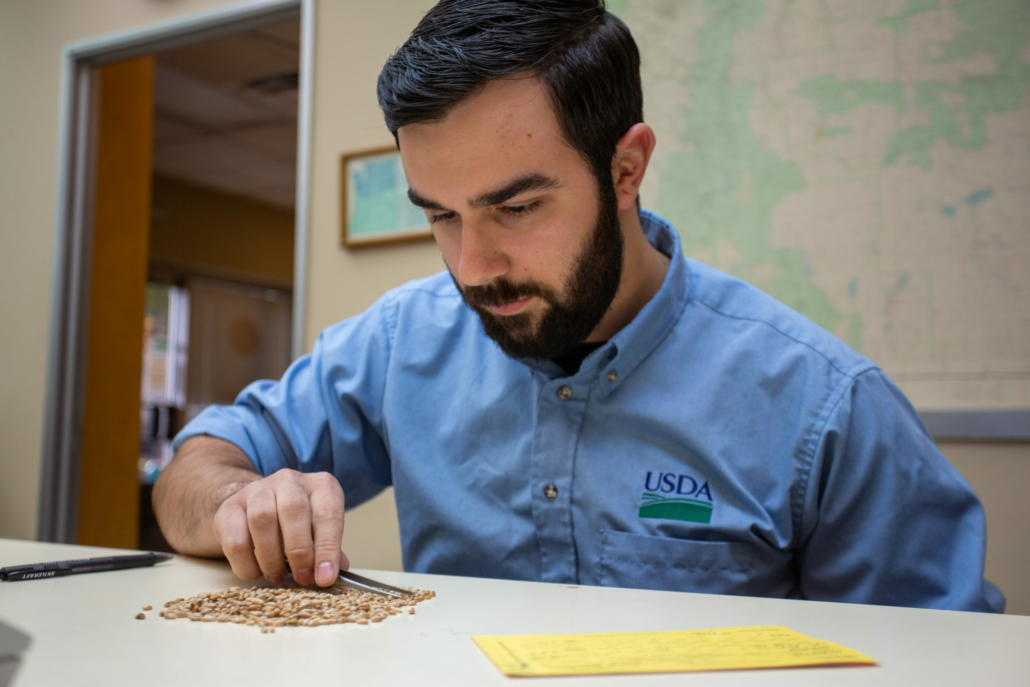
Photo shows an FGIS inspector and wheat kernels demonstrating another reason why U.S. wheat is the world's most reliable choice.

The Federal Grain Inspection Service (FGIS) independently inspects wheat at vessel loading to certify that the quality loaded matches the quality stated in the customer’s contract. Those inspections yield valuable data down to the sub-lot level of 1,000 to 2,000 metric tons that customers can use, with assistance from USW, to get the most value from their tenders.

The Federal Grain Inspection Service (FGIS) independently inspects wheat at vessel loading to certify that the quality loaded matches the quality stated in the customer’s contract. Those inspections yield valuable data down to the sub-lot level of 1,000 to 2,000 metric tons that customers can use, with assistance from USW, to get the most value from their tenders.

Direct Government Export Intervention is Banned

The world’s most reliable choice is protected by several U.S. federal laws that assure the sanctity of all export contracts. The only exception is a declared national emergency. Export tariffs are forbidden in the U.S. Constitution, fully adhering to World Trade Organization disciplines, and U.S. policy prevents using food as a weapon.


To Read More, Visit : US Wheat 


#uswheatexpert #usawheatproduction #wheatexportusa #wheatbuyers #wheatmiller #foodprocessor

Comments

Popular posts from this blog

How much wheat does it take to make a pound of flour?

  To understand how much wheat it takes to make a pound of flour, it’s important to delve into the  wheat industry , the processes involved in transforming wheat into flour, and the role of organizations like  Wheat Associate.  This information is essential for  wheat food processors  and anyone interested in the journey of wheat from the field to the kitchen. 1. The Basics of Wheat to Flour Conversion On average, it takes approximately 1.25 pounds of wheat to produce one pound of flour. This conversion is a fundamental aspect of the wheat industry, where efficiency and yield are key factors. The slight excess of wheat required accounts for the removal of bran and germ during milling, which are not included in refined flour. 2. The Milling Process The transformation of wheat into flour involves several steps: Cleaning:  Wheat kernels are cleaned to remove impurities such as stones, dust, and other foreign materials. Conditioning:  The cleaned whea...

What is the difference between rice and wheat?

  Rice and wheat are two of the most widely consumed grains globally, each offering distinct nutritional profiles, cultivation methods, and culinary applications. As promoted by the  US Wheat Associates , an organization dedicated to advancing the interests of  US wheat  producers and exporters, understanding these differences is crucial for making informed dietary and agricultural choices. Wheat, a staple in many parts of the world, belongs to the Triticum genus and is commonly ground into flour for making bread, pasta, and pastries. It contains gluten, a protein complex that provides elasticity to dough, aiding in the rising process. This makes wheat-based products popular choices for baking, resulting in fluffy and chewy textures. Wheat's versatility is showcased through its various forms like hard red, soft red, and durum, each suited for specific applications. Rice, on the other hand, is a cereal grain primarily grown in flooded fields known as paddies. It is a ...

How is wheat harvested, and what effect does this have on the environment?

 Wheat is a critical crop for the United States and is one of the most widely cultivated grains in the country. It is used to make a wide range of foods, from bread and pasta to cereal and snacks. In this article, we will explore the process of harvesting wheat in the United States, as well as its environmental impact. Harvesting Wheat in the USA Wheat is typically planted in the fall or spring and grows through the winter or summer months, depending on the variety of wheat. When the wheat is ready to be harvested, farmers will use a combine harvester to cut the stalks of wheat, separate the grains from the chaff, and collect the grain in a bin on the combine. The combine harvester is a large machine that is driven through the fields of wheat. It has a cutting header at the front, which cuts the stalks of wheat close to the ground. The wheat is then fed into a threshing drum, which separates the grain from the straw and chaff. The grain is then collected in a bin on the combine, wh...