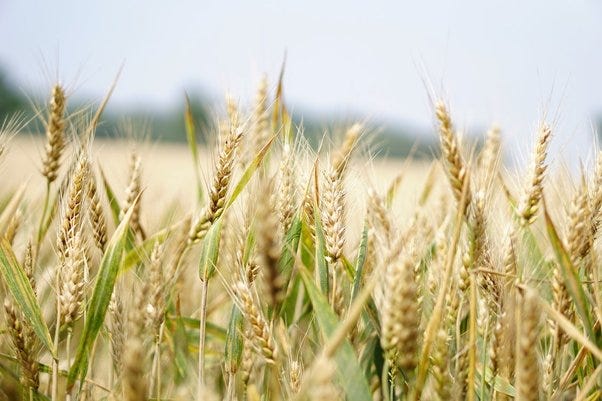
Wheat has been central to civilizations both past and present, providing sustenance necessary for human development.
Overview
Wheat is one of the crops most central to the development of human civilization. It has been consumed since before formal civilization, while humans were still hunter-gatherers. Once wheat had been domesticated and farming was commonplace, populations grew and expanded.
As nations developed economies, agriculture, specifically wheat production, generated jobs and profits for countries. This project looks at the origin of wheat in the Fertile Crescent, then its expansion to Greece and Germany. We take a look at Ancient Egypt, and specifically the Nafutian tribe in Levant. After, we move to the United Kingdom, before looking at the United States of America, where we detail how wheat impacts four different states. Then, we look at the impact of wheat in Russia, Turkey, and China.
The Early Cultivation of Wheat
The beginning of our journey takes us to the Fertile Crescent, a geographical area situated between the Mediterranean Sea, Red Sea, and Persian Gulf once known as “Mesopotamia”. The earliest cultivated wheat is emmer wheat. Emmer wheat was first cultivated in 8500 B.C.
In What Climate Does Wheat Best Grow?
Wheat does not require a lot of water to grow, it only needs about 31–38 cm of water. Wheat grows best in a warm climate with temperatures around 21° to 24° C. Climates with low humidity result in better wheat yields. The semi-aired and slightly dry climate of the Fertile Crescent, paired with the rich soil from the nearby rivers and seas made for a wonderful wheat-growing environment.
Civilization Beginnings
Food stability is central to civilization growth. Hunting-gathering was replaced by farming as populations grew, because a more predictable and large-scale food production was necessary for a growing population. Grains, wheat included, are an easy-to-grow, energy-dense food that was central to many early civilizations.
The end of the last ice age gave way to a period of global warming and heavy rainfall, making the overall climate better suited for wheat cultivation. The rising consumption of wheat resulted in more overall wheat growth. Wheat cultivation resulted in more food per acre, which fed larger amounts of people, thereby prompting larger populations, resulting in an exponential cycle of population growth .
Wheat has the highest protein percent out of all grains, and third highest energy content, after rice and corn . Wheat is an incredibly versatile and adaptable grain, and is able to grow in most climates, making it a staple item in many culture’s diets .
Wheat Moves Northwest
As previously stated, wheat is a very adaptable grain and can be grown in many climates. Wheat started to make its way beyond the Middle East, going northwest, towards Greece. Wheat reached Greece around 6500 B.C. 1,500 years later, around 5000 B.C., wheat was in Germany
Wheat Cultivation
Wheat harvest was a multi-step process. First you must cut the stalks. A common technique was cutting the straw “high above the ground, some- times just below the heads. This practice, also common in medieval Europe, made for easy harvesting, easier transport of the crop to the threshing floor, and cleaner threshing”
Then, the wheat must be dried. After it is dry, which can take up to two weeks. After the stalks are sufficiently dried, the threshing begins. Wheat stalks are ‘threshed’, to remove the outer shell and retrieve the grains inside, which is what we eat. Then, wheat is ‘milled’. Milling is a process that turns the whole grains into flour, which can be used for cooking and baking. Mills have been ran with water, wind, and animal energy. But in some Roman mills, slave labor was used. Milling by hand is a grueling and torturous task.
Wheat goes Global
Wheat continued to spread across the world as civilizations expanded and trade grew. Wheat has made such a large impact on the world’s agriculture because it does not require a lot of water to grow. It’s easy to grow and has many uses, making it a cornerstone of the world’s agriculture. Wheat is currently grown on every continent except for Antartica. Worldwide, wheat covers about 870,000 square miles of the globe’s surface, almost ten times the size of Britain (Harari 80).
Wheat is the most harvested crop in the world. Global wheat production generates about $168 million annually, making it one of the highest earning crops (Wikipedia, from United Nations Food and Agriculture). We can thank wheat for sustaining our population through its easy grow cycle and favorable energy ratio. The large-scale production of wheat is undeniably critical to the state of humanity today.
U.S. Wheat Associates — Dependable People, Reliable Wheat
U.S. Wheat Associates (USW) is the export market development organization for the U.S. wheat industry. USW promotes the reliability, quality and value of all six U.S. wheat classes to wheat buyers, millers, bakers, food processors and government officials in more than 100 countries around the world.
Its mission is to “Develop, maintain, and expand international markets to enhance wheat’s profitability for U.S. wheat producers and its value for their customers.”
Funding is made possible through checkoff dollars, goods and services from 17 state wheat commissions and cost-share grants from the USDA’s Foreign Agricultural Service.
USW does not buy, sell, or process wheat; we do help make it easier for everyone else who does.
Wheat farmers in post-World War II United States were producing more wheat than ever before. So, to improve marketing opportunities, they organized and reached out to the U.S. Department of Agriculture (USDA) for help. These visionary state wheat leaders ultimately formed two regional organizations to coordinate export market development: Western Wheat Associates and Great Plains Wheat Market Development Association.
To know more visit: https://www.uswheat.org/about-usw/#toggle-id-2
Comments
Post a Comment